

Also known as phototherapy and photobiomodulation; is where specific wavelengths of light are used for therapeutic benefits.
Phototherapy started out as successful NASA technology to grow plants in space without sunlight and then passed into the medical and beauty arena. An increasing number of published articles can be found to support the effectiveness of these wavelengths on mitochondrial stimulation (RED & NIR) and suppression of bacterial infections (BLUE). Research is continuing at pace and light therapy is showing huge amounts of promise for many inflammatory and bacterial conditions.
The Wavelengths
Blue – Wavelength 465nm (±5nm)* (visible light spectrum)
Red – Wavelength 635nm (±5nm)* (visible light spectrum)
Near Infrared – Wavelength 850nm (±5nm)* (invisible light spectrum)
*±5nm = means give or take 5nm on the wavelength specified. This is still within the efficacy range.
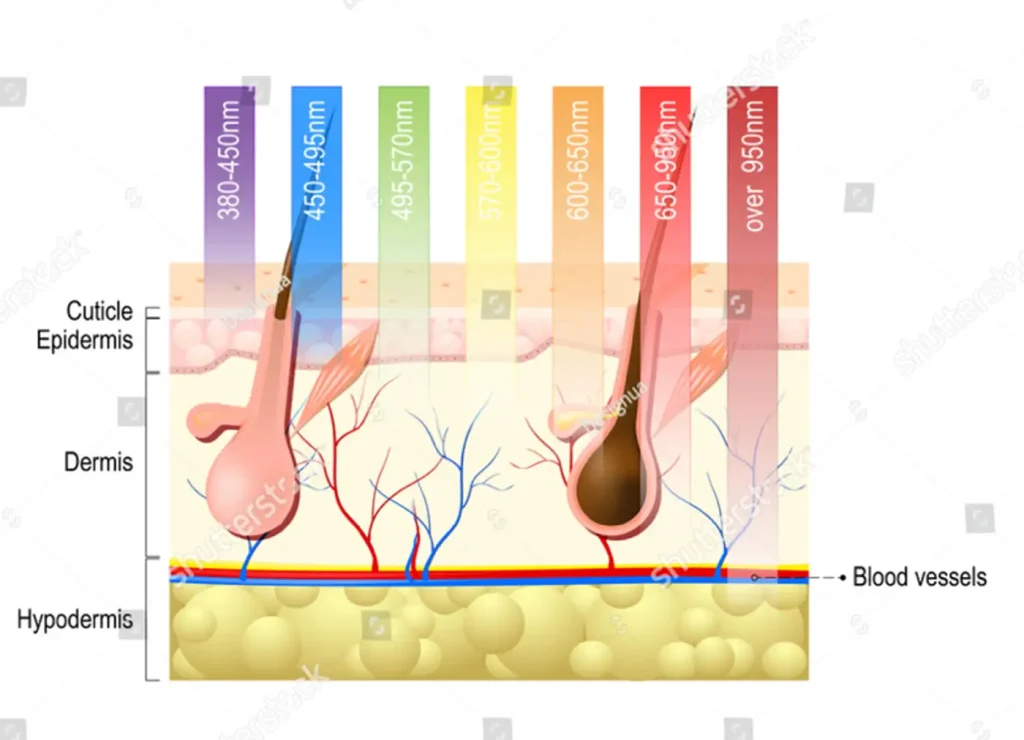
As you can see, shorter wavelengths have more superficial penetration and longer wavelengths penetrate deeper into the tissues.
Here is a summary of the different wavelengths and their action on skin:
Blue Light actively destroys pathogenic bacteria and other microbes so is useful in the control of skin issues known to be caused by an overgrowth of bacteria, mites, fungi, virus or associated with an imbalance in the microbiome (which is basically all of them!)
- Acne (Cutibacteria acnes or C.acnes)
- Rosacea (possible Demodex mite but more likely an imbalance of commensal /pathogenic bacteria)
- Seborrheic Dermatitis (malesezzia fungi)
- Peri-oral Dermatitis/other dermatitis (imbalance of commensal/pathogenic microbes)
- Eczema (over abundance of staphylococcus aureus)
Blue light is absorbed by photosensitive parts of microbial cells (of which pathogens have more than commensal microbes) and creates ROS (reactive oxygen species) which are unstable, destructive oxygen molecules.
These ROS exert high levels of oxidative stress on the bacterial cells destroying the cell membrane, cell wall and genetic material ultimately leading to apoptosis (cell death).
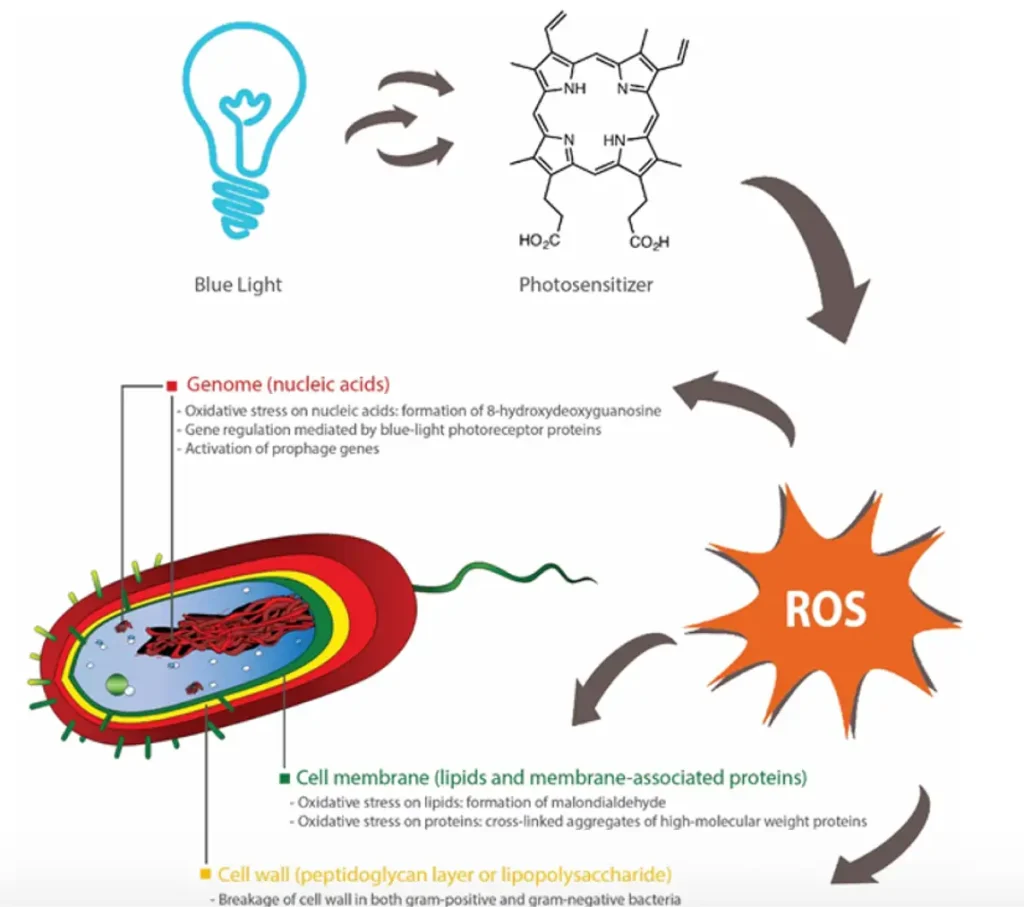
This technology is so effective that there is exciting research into how blue light could control antibiotic resistant infections such as MRSA, and in other areas where microbial control is necessary such as medical settings, dentistry and food safety.
Red and NearInfrared stimulate mitochondrial activity
Mitochondria are found in every cell of our body, with the exception of red blood cells and are our energy producing factories. I like to think of them as your cell batteries and the more charged up they are the better EVERYTHING functions.
Red and NIR are both proven to stimulate mitochondria therefore producing more energy or ATP (the energy molecule of cellular respiration).
Hundreds of clinical studies and real world application on skin show red and near infrared light increases cellular repair, reduces inflammation, speeds up wound healing, stimulates collagen synthesis, improves skin texture and stimulates blood flow.
The combination of Red+NIR light is seen as the gold standard in photobiomodulation and because of all these amazing effects they are fantastic for all skins including sensitive and inflammatory disorders*
Using LED light therapy at home consistently will yield far better results than monthly clinic treatments.
Whether you pay £200 or £2000 for a device you will still get the same results as long as it has the correct clinical wavelengths mentioned above. Also look for “FDA approved” and “Grade 2 medical device”.
The price of a device usually increases if it is “branded” but doesn’t mean it’s better.
If you have a chronic skin condition or want to treat skin on different areas of the body then a panel device is optimal. LED Panel devices are much stronger and more effective than LED face masks as they can be designed with more powerful bulbs (which emit some heat so couldn’t be used in direct contact devices).
If you feel you have the inclination to use a panel then it is the better choice but if the convenience of a face mask means you will be more likely to use it 3 x a week, then it may be the better choice FOR YOU. Remember, consistency is the key!
General Tips for using your LED device:
Morning use improves results due to correlation with circadian rhythms. Our cells respond better to light in the morning.
My tip for using an LED face mask in the morning: keep your LED mask next to your bed and three times a week on Monday, Wednesday Friday (or other days of your choosing ) set your alarm 10/20 minutes before you would normally need to wake up, put your mask on and then set your alarm to snooze for 10/20 minutes depending on your treatment time.
Having said that if the morning is not good for you then choose a time when you are most likely to stick to the routine of 3 x per week. Ultimately it’s CONSISTENCY that matters, not so much time of day.
Ideally, skin should be clean and free of any lotions or oil containing products as this will block the light rays. If using your LED as described above don’t worry about prepping the skin prior to applying the mask – any natural skin oils produced overnight are negligible especially in inflammatory situations. Even water-based products can block the light if applied immediately before using light therapy. If you want to apply a serum beforehand make sure it has had time to absorb (20-30 mins).
After LED there is nothing in particular you need to do. You can use any of your skin care products or none at all. It’s the light that does the work!
LED 3 times per week is optimal – studies show that more than 3 sessions do not improve outcomes further.
Improvements should be seen within 6 to 12 weeks of consistent use.
Protocol for active Acne/Rosacea/any kind of dermatitis and Eczema*
10mins red/nir combined x 3 per week
10mins blue x 2 per week
You can do a total of 5 x 10min session per week or 3 sessions with 2 of those using 10min Red+NIR first followed by 10 mins blue.
*LED therapy is extremely safe and is totally comfortable for the vast majority of people but as you have learnt RED & NIR lights increase energy production therefore “excite” cells which can create heat, so, if you have a lot of inflammation and you find that your skin gets hot or uncomfortably flushed during treatment try just the NIR on its own instead of Red+NIR combined.
Then, over the course of a few weeks, try starting with 1 minute of red light only, then 2 mins the following week and so on.
Always be guided by sensations on your skin – if it feels hot or uncomfortable start very gradually and slowly build up.
Once there has been some good improvement in symptoms then you can drop the blue light to 1 x per week.
If your skin is not showing visible signs of the above conditions but you just want to maintain your results or use for general skin health the optimal protocol is just 10 mins 3 x per week red + NIR combined.
Because the blue light destroys mostly pathogenic bacteria we only need to use it when there is an active flare.
A note on darker skin tones and melasma.
Pigmentation as we know, is stimulated by sunlight but also can be affected by heat too.
Melasma and darker skins with pigmentation issues need to be treated from the inside out as the pigment tends to sit deeply within the skin layers. Eumelanin (that creates darker pigment) absorbs red light very well therefore can create more heat than in lighter skins, so if you are Fitzpatrick 3 or above then sticking with NIR on its own instead of Red+NIR combined is best.
NIR works deeper than RED light and also creates less heat so in this case is preferable.
For lighter skins (Fitzpatrick 1-3) with sun induced pigmentation the gold standard RED & NIR combination is recommended.
If you have light skin and melasma (usually manifests as symmetrical pigment over forehead, upper cheeks, upper lip) then use NIR only for 12 weeks. Once pigment is resolved then RED light can be added in.